

Compounded Plastic Explained: Why Manufacturers Use It
In the world of polymer engineering, raw plastic resin rarely delivers the performance modern applications demand. As a result, manufacturers modify plastics through compounding to meet strict requirements for lightweight electric vehicle components and sterilisation-resistant medical devices. Therefore, this process defines compounded plastic.
Although “plastic compounding” is a standard industry term, engineers and manufacturing managers specify compounded plastics in practice to control performance, ensure consistency, and reduce production risk across production environments.
Article Contents
What is compounded plastic?
Compounded plastic is a polymer material made by blending base resin with additives and fillers to deliver controlled mechanical, thermal, electrical, or aesthetic properties for manufacturing applications.
What is plastic compounding used for?
Plastic compounding is used to tailor material performance before moulding, improving consistency, processing stability, and reliability in applications such as automotive, electronics, medical devices, and industrial components.
What is the difference between compounded plastic and masterbatch?
Compounded plastic contains additives uniformly blended into every pellet, while masterbatch relies on mixing concentrates at the press. As a result, compounding provides more consistent properties and supports higher filler or fibre loadings.
What is compounded plastic?
In simple terms, compounded plastic is a plastic formulation created by melt-blending a base polymer (resin) with specific additives, fillers, and modifiers.
Unlike “neat” or “virgin” resin, which leaves the reactor with fixed, basic properties, a compounded material is customised to meet defined performance targets. For example, these targets may include:
- Mechanical strength: increased stiffness or impact resistance
- Thermal properties: flame retardancy or heat stabilisation
- Electrical or thermal conductivity: controlled conductive behaviour
- Aesthetics: precise colour matching or surface finish
When Should You Use Compounded Plastic?
Manufacturers use compounded plastic when material performance must be controlled before moulding rather than adjusted at the press.
In practice, compounded plastics are specified when:
- part failure carries high cost or regulatory risk
- tight dimensional tolerances are required
- high filler or fibre loadings are needed
- cosmetic consistency matters at scale
- scrap reduction and process stability are priorities
By contrast, simpler or low-risk applications may still rely on masterbatch systems. However, as quality requirements increase, compounding becomes a decision for reliability rather than materials alone.

The “Salt & Pepper” Mix vs. Fully Compounded
A common source of confusion in plastics manufacturing is the difference between a simple blend and a fully compounded material.
- Dry blend (“salt & pepper”): the moulder mixes natural resin pellets with colour or additive concentrate (masterbatch) pellets immediately before moulding. As a result, final material quality depends heavily on the moulding machine’s screw design and processing stability.
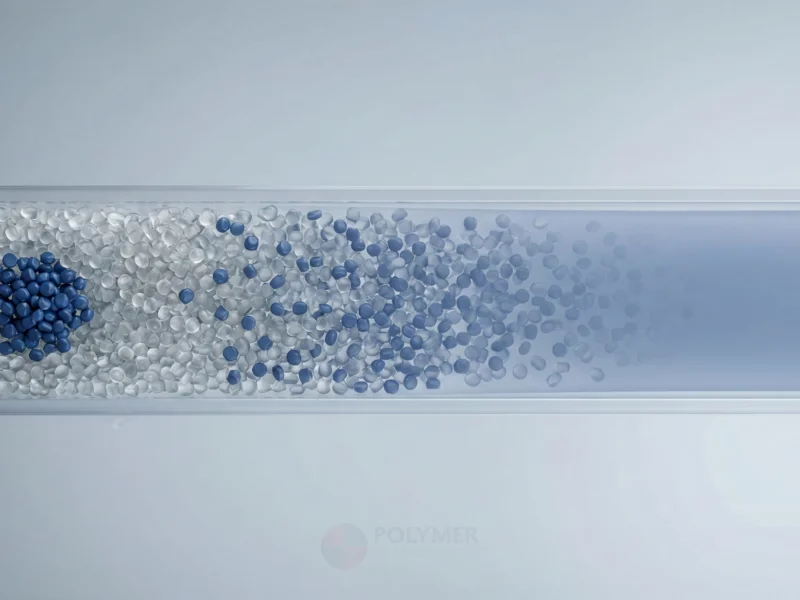
- Fully compounded: compounders melt and mix resin and additives at a molecular level before re-pelletising. Consequently, every pellet contains the same formulation, ensuring consistent performance.
Compounding vs. Masterbatch: Which Is Better?
To fully understand compounded plastic, it helps to compare it with its primary alternative: the masterbatch method. While both approaches serve valid purposes, compounding offers clear advantages for high-performance and regulated applications.
| Feature | Masterbatch (at the press) | Fully compounded plastic |
|---|---|---|
| Consistency | Risk of swirls or uneven dispersion | Identical pellets, uniform dispersion |
| Convenience | Requires dosing equipment | Plug-and-play |
| Total cost of ownership | Lower material cost | Lower scrap and defect rates |
| Performance | Limited let-down ratios | High filler and fibre loadings |
Verdict: Masterbatch suits commodity products such as toys or simple containers. However, compounded plastic is essential for engineering applications — including automotive gears and electronic housings — where failure is not an option.
Standards explained (UL 94, ISO 9001, ISO 14001): In many engineering applications, compounded plastics must align with recognised performance and management standards. UL 94 defines how plastic materials behave when exposed to flame and is commonly required for electrical, electronic, and automotive components. ISO 9001 supports controlled production and traceability, while ISO 14001 focuses on environmental management and sustainability practices. Although not every compounded plastic requires certification, these standards often influence material selection in regulated or high-risk environments.
The Compounding Process: How It Works
At the core of a compounding facility is the extruder. In most cases, high-quality compounding uses twin-screw extruders, although single-screw systems also exist.
Step 1: Feedstock Selection
First, the process begins with the base resin. Common polymers include:
- Commodity: PP, PE, PS
- Engineering: PA, PC, ABS, PBT
- High-performance: PEEK, PPS, PSU
Explore materials:
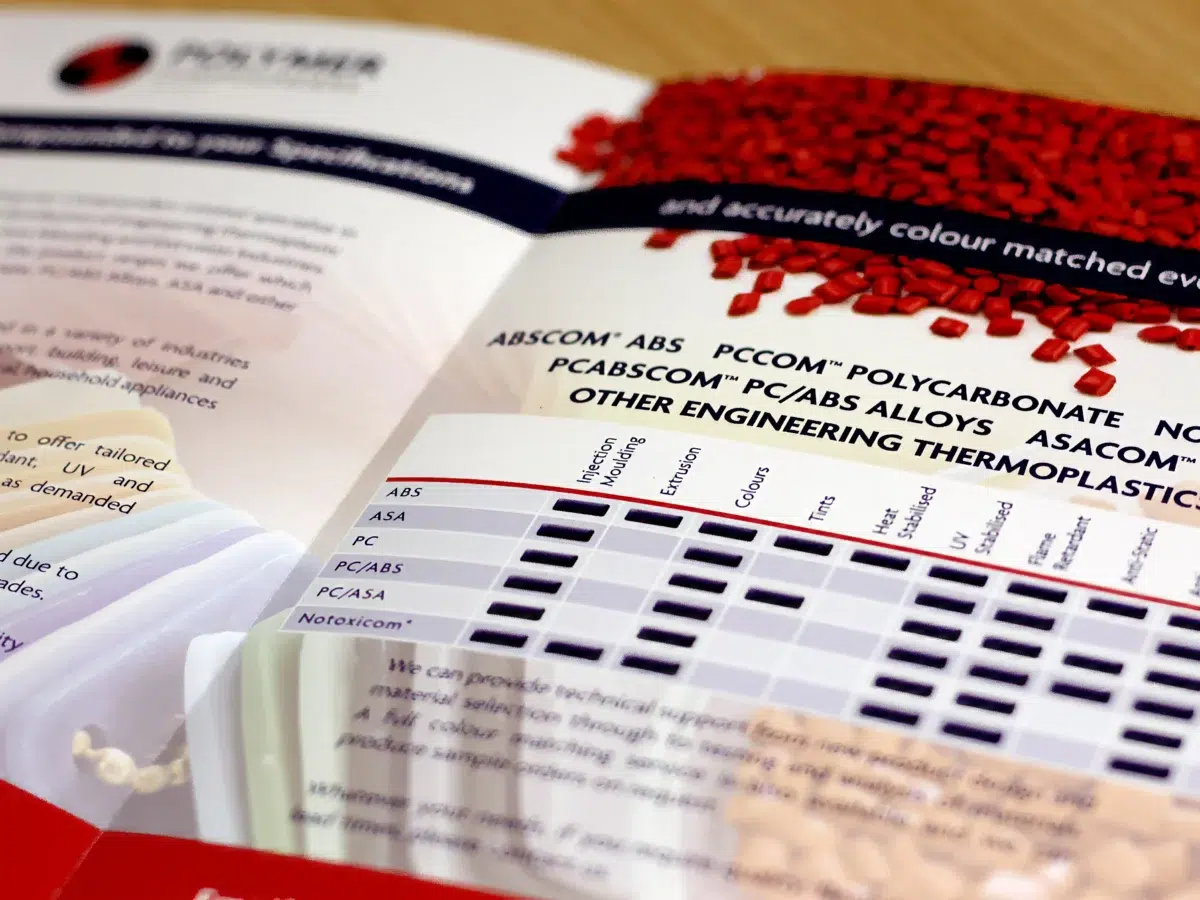
PC/ABS compounds,
ABS compounds,
ASA compounds,
Step 2: Dosing and Mixing
Next, resin and additives enter the extruder via precision gravimetric feeders that maintain recipe accuracy to fractions of a percent.
Step 3: Melt Blending
Inside the barrel, intermeshing screws shear and melt the plastic through heat and friction. As a result, pigments and fillers disperse evenly throughout the polymer matrix. In some cases, side feeders introduce fibres downstream to prevent breakage.
Step 4: Stranding and Pelletising
Once molten, the compound exits through a die, forming strands that pass through a water bath before pelletisers cut them into uniform pellets. For sticky or highly filled materials, underwater pelletisers are often used.
Step 5: Quality Control (QC)
Finally, in regulated industries, compounders provide batch traceability, certification, and long-term formulation consistency. Accordingly, reputable compounders test each batch for melt flow index, impact strength, density, and colour accuracy.
The Additive Ecosystem: Customising the Molecule
What makes compounded plastic so powerful is the formulation itself. To achieve this, compounders draw from a wide library of ingredients, including:
- reinforcing fillers
- impact modifiers
- flame retardants
- stabilisers
- sustainable fillers
Explore grades:
Flame-retardant plastics (UL 94),
Electrically conductive plastics,
PCR compounded plastics.
Market Trends: The Rise of Eco-Compounds
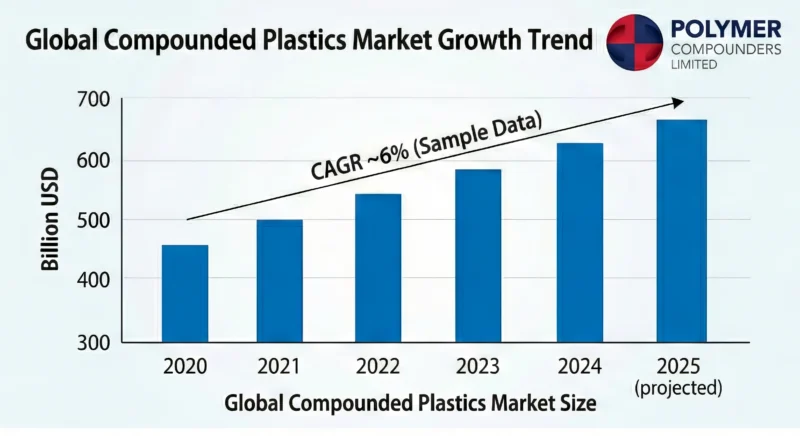
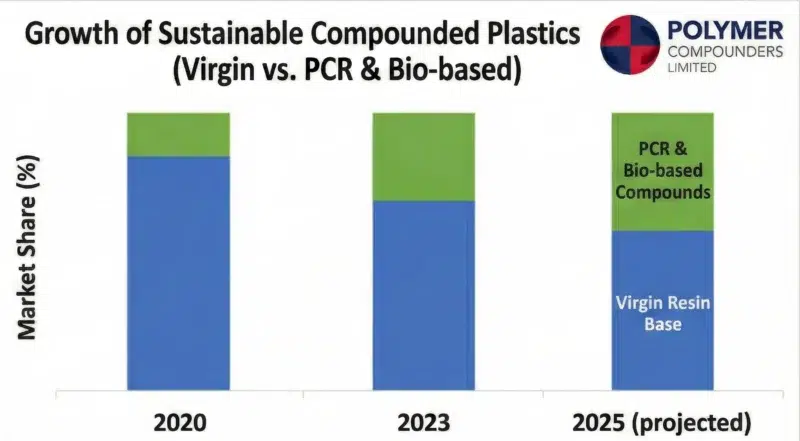
In recent years, the compounded plastics market has shifted toward sustainability-driven solutions.
Post-Consumer Recycled (PCR) Compounds
Increasingly, compounders upcycle recycled resins by restoring performance through stabilisers and modifiers, thereby creating near-prime materials.
Metal Replacement (Lightweighting)
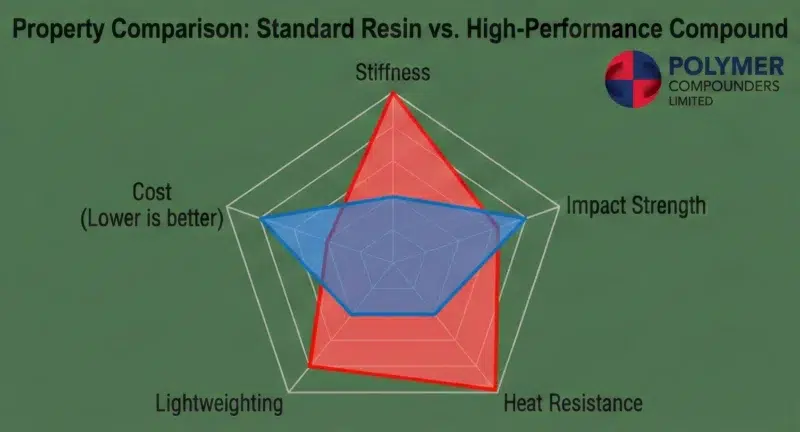
Meanwhile, in automotive applications, highly compounded plastics replace metal parts to reduce weight, resist corrosion, and improve efficiency.
Bio-Plastics
At the same time, compounding enables bio-resins such as PLA and PHA to perform reliably in durable applications.
Conclusion
In summary, compounded plastic enables precise, predictable performance for demanding applications by transforming basic resin into a specialised engineering solution.
Ultimately, manufacturers choose compounded plastic not just for chemistry, but to minimise risk, control variability, and lock in performance before production begins. As standards tighten and sustainability pressures increase, compounded plastics are becoming the default choice for production-ready components.
Frequently Asked Questions
Is compounded plastic better than masterbatch?
Compounded plastic is not always better than masterbatch, but it is preferred for high-performance or regulated applications because it offers greater consistency, higher filler loadings, and lower production risk. Masterbatch suits lower-risk or commodity parts.
When should manufacturers use compounded plastic?
Manufacturers use compounded plastic when material performance must be controlled before moulding, especially for tight tolerances, regulatory requirements, cosmetic consistency, or applications requiring high filler or fibre content.
Can compounded plastics contain recycled material?
Yes. Compounded plastics can include post-consumer recycled (PCR) content. During compounding, stabilisers and modifiers restore consistency and performance, allowing recycled polymers to meet demanding manufacturing requirements.
What industries use compounded plastics?
Compounded plastics are commonly used in automotive, electrical and electronics, medical devices, industrial equipment, and consumer appliances where predictable performance and repeatable processing are essential.
Sources, Standards & Further Reading
Technical & Processing References
- Cataldi, P., et al. (2020). Biopolymer composites: Processing, properties and applications. Polymer Composites.
- Hall, S. (2023). Sustainable fillers and additives in plastic compounding. Plastics Today.
- Thermo Fisher Scientific. Twin-screw extruders: principles and applications.
- Thayer Scale. Gravimetric feeders in plastics processing.
- Coperion GmbH. Compounding fundamentals and process design.
- Maag Group. Underwater pelletising systems for polymer compounding.
- SpecialChem. Melt flow index (MFI): definition and testing in polymers.
- MatWeb. PA66 GF50 material properties.
Market & Industry Context
- PlasticsEurope (2025). Plastics – the Fast Facts.
- Smithers (2024). The Future of Polymer Compounding to 2030.
Standards & Compliance
- UL 94 – Tests for flammability of plastic materials
- ISO 9001 – Quality management systems
- ISO 14001 – Environmental management systems